
Date: September 20, 1849
Location: Bangor, Maine.
The following communication refer to a palpable case of spiritual transit to the other world, and the prophetic announcements are among the facts which forever remain to puzzle and rebuke the skepticism of unbelieving men.
[Ed.]
To Editor of the Telegraph: Dear Sir:
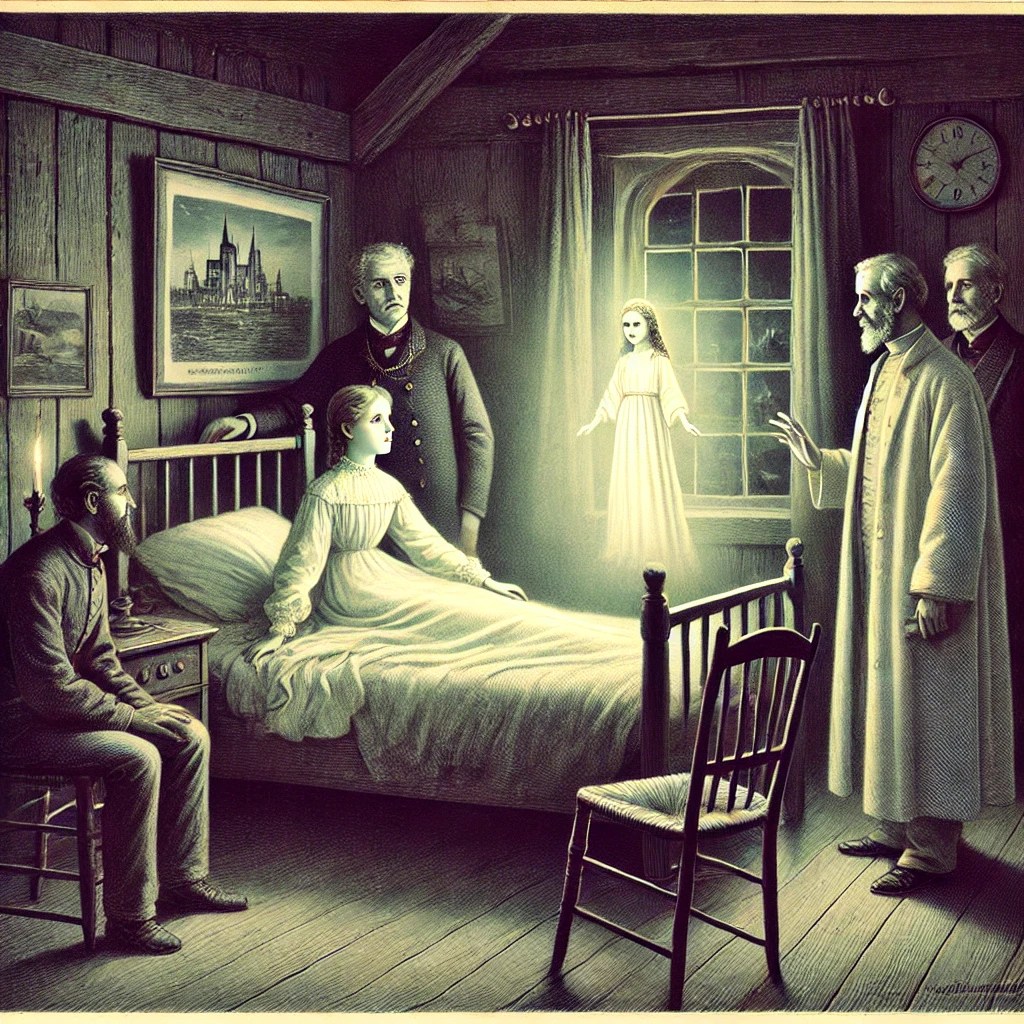
During the summer of 1849, the city of Bangor, Me., in common with most other cities of the United States, was visited by cholera. On Thursday, Sept. 20, Mrs. Hangley, the wife of a poor Irish laborer, of that city, died of that disease. Two days afterward his daughter, Margaret, a child of seven years old, died (as was supposed) of the same disease. The body was prepared for burial, and the father applied to W. R. Wingate, Esq., one of the city Aldermen, for a coffin. Owing to some cause, not explained, the delivery of the coffin was delayed for some time.
While awaiting its arrival, the child suddenly revived, and stretching forth her hands, exclaimed: “Oh, father! I have been to heaven! It is a beautiful place!” She then told what she had seen, and how glad she was to find her mother alive and well. She saw many children whom she knew and named; among others, seven cousins, four of them the children of her uncle Hangley, and three of her uncle Casey, adding, “Aunt Lynch is not there now, but she will be to-morrow; and on Sunday afternoon, at four o’clock, I shall go back again.” An older sister observed, “You could not have seen three of uncle Casey’s children, my dear, for there are but two of them dead,” naming them. “But I saw John there, too,” she replied. “They were with mother. They were all dressed in white. Oh! they looked so happy; and, to-morrow at 4 o’clock, I shall return again.”
The father now informed Alderman Wingate of the circumstances, when that gentleman, accompanied by Dr. S. B. Morison, city physician, called at the house, and she repeated to them what she had before stated.
Shortly after this, a message was received from Mr. Casey, who resided in Carmel—some twelve miles distant—informing them of the death of another child, John, and inviting them to attend the funeral.
At this time, it was not supposed that her “aunt Lynch” was dangerously ill—but she died the following day, as stated by the child.
There was still another prediction remaining to be fulfilled: that she would go back again, at a certain time. On Sunday afternoon, Mr. Daniel Warren, a man of active benevolence, called at the house. This gentleman spent most of the time during the prevalence of the cholera in visiting the sick. He engaged her in conversation, and endeavored so to occupy her mind that the time might pass unperceived. She soon, however, appeared to be sinking. Her pulse gradually failed, and finally stopped, or became imperceptible; no evidence of breathing could be discovered; and she again lay before them, apparently dead. There was no clock in the house, and Mr. Warren immediately threw open the widow [sic.] to get a view of the town clock, at a distance. It was at that moment striking four. She remained, to all appearance, dead, for the space of half an hour; when she again revived, and finally recovered; and, as late as the following December, was alive and well, though the eldest sister, spoken of above, died and was buried a few days afterwards.
These facts were published, some time afterward, in the Bangor Whig. After reading the account, I addressed letters to Alderman Wingate, Dr. Morison, and Mr. Warren. I received replies from all of them corroborating the statement, and giving further details, unnecessary to mention.
Yours, &c.,
B. C. M.
Bangor, Dec. 20, 1849
Mr. B. C. Macy: Dear Sir:
A few day [sic.] ago I received a line from you, stating that you had seen a statement, taken from the Bangor Courier, respecting the Hangley girl, who apparently died twice, and returned to life again, during the dreadful ravages of the cholera, in this city. You wished me to write and inform you if it was true. I was present at the second time of her apparent death and return to life again.
Among others, Margaret Hangley, a little Irish girle, about seven years old, was seized with the cholera, Saturday, Sept. 22, 1849, and apparently died, and remained in that state an hour or two. I was not present when they sent for the coffin, but I was at the house soon after she revived, and remained with her for some time. She was very weak, but appeared very happy; said she had been to heaven, and it was a beautiful place. She saw her mother in heaven. (By the way, her mother died of the cholera, and was buried Thursday, Sept. 20.) She related to me—in substance, respecting her friends in heaven—that you saw in the paper. Speaking of her aunt Lynch, she said she would be in heaven to-morrow. I was credibly informed that she, (her aunt Lynch,) died the next day and was buried.
The four of her uncle Hangley’s children, whom she said she saw in heaven, were dead, as stated in the paper. She said that she saw three of her uncle Casey’s children in heaven. Her friends insisted that it could not be so, for only two of them were dead. “Yes,” she said, “I saw three of them in heaven.” The same day the news came from Carmel—the distance of about twelve miles—that little John Casey was dead—the child referred to by the entranced as being in heaven. This was Sept. 22. She also told me, as she did others, that she should go to heaven again to-morrow, at 4 o’clock, to see her mother. I asked her how she knew? She said, “God told me so, and mother told me so, too.” She said she wanted to go to heaven to see her mother, and be with God. I think she said nothing about dying, but frequently spoke of going to see her mother.
The next morning I saw her again; she said she was going to heaven to see mother at 4 o’clock that day. I called again in the afternoon; I endeavored to encourage her; I told her she appeared better, and would be out in a day or two. “But I am going to mother again at 4 o’clock.” “When, to-morrow?” “No, to-day.” Soon after, she seemed to be fast expiring in death: her pulse stopped; she ceased to breathe, and, to all human appearances, she was dead. I instantly raised the window to look at the town clock in the distance; it was striking four that moment. I heard it distinctly. In about half an hour she began to revive, but she was very weak.
The city physician told me, the next day, that he thought she would not recover. But she did recover, and now en-joys good health. I saw her father to-day.
The second time she apparently died, she had similar views of heaven, as she had the day before.
The above statements are the plain, simple facts.
Yours, with respect,
Daniel Warren
Union-st., Bangor, Me.
Bangor, Dec. 3, 1849.
B. C. Macy, Esq.: Dear Sir:
Yours of the 11th instant, making inquires as to the child of Mr. Hangley, is received. Both Mr. Wingate and myself were at the father’s house, soon after she came out of the “trance.” She related to me what she saw while ‘in the state when she was supposed to be dead.’ The account, which was published in the Whig, was correct in all the material points, and we know of very few persons, if any, in Bangor, who are disposed to dispute it. Though some treat the affair as simply the result of a dream, while others think it was in accordance with the views of the New Church. Neither of us, however, belong to that Church, not have any particular sympathy with it [sic.] doctrines.
The girl is now in her usual health, and recently stated to me, that she recollected what she saw when she had the vision, or trance. She repeated, nearly verbatim, what she told me at first. Though questioned for some time, she was not inclined to say any thing about what transpired on the Sabbath afternoon referred to.
Most respectfully, yours,
S. B. Morison, City Physician,
W. P. Wingate, Alderman.
Spiritual Telegraph, (New York: Charles Partridge, Vol. 1, No. 27, November 6, 1852), p.1-2.
 The Katabasis Project
Leave a comment