
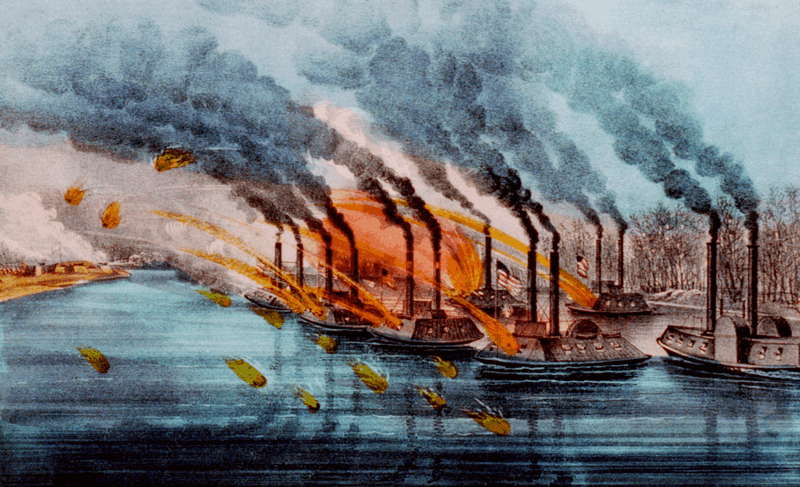
Date: February, 1862. (Battle of Fort Henry, American Civil War)
Location: Near Stewart County, TN, USA.
April 22nd, 1884
I received my degree from Rush Medical College, Chicago, Ill., at the close of the session 1857-8, and having said so much will proceed to give you as clear and complete a statement of the occurrence to which you allude as I can. Early in February, 1862, the 18th Regiment Illinois Volunteer Infantry, of which I was Assistant-Surgeon, was ordered from Cairo to join in the attack on Fort Henry. The surgeon went with the regiment, and left me with the sick in the Regimental Hospital—about 30—among whom was Albert Adams, sergeant-major of the regiment. He was an intelligent and estimable young man, who had recently been in attendance, and I think graduated at a Literary College. I had removed young Adams from the hospital proper to a room in a private house—one that had been quite large—but a smaller room had been partitioned off at one end with a board partition, which was, I think, canvassed and papered; and in the smaller room so partitioned off was my wife, who is now, besides myself, the only person who heard the speaking whose whereabouts I know. Seeing the young man would die, I had telegraphed, and his father came at 4 or 5 p.m. During all the afternoon he could only speak in whispers, and at 11 p.m. he to all appearances died. I was standing beside his father by the bed, and when we thought him dead the old man put forth his hand and closed the mouth of the corpse (?), and I, thinking he might faint in the keenness of his grief, said “Don’t do that! perhaps he will breathe again,” and immediately led him to a chair in the back part of the room, and returned, intending to bind up the fallen jaw and close the eyes myself. As I reached the bedside the supposed dead man looked suddenly up in my face and said, “Doctor, what day of the month is it?” I told him the day of the month, and he answered, “That is the day I died.” His father had sprung to the bedside, and turning his eyes on him, he said, “Father, our boys have taken Fort Henry, and Charlie” (his brother) “isn’t hurt. I’ve seen mother and hte children, and they are well.” He then gave quite comprehensive directions regarding his funeral, speaking of the corpse as “my body,” and occupying, I should think, as much as five minutes. He then turned towards me, and again said, “Doctor, what day of the month is it?” and when I answered him as before, he again repeated, “That’s the day I died,” and instantly was dead. His tones were quite full and distinct, and so loud as to be readily heard in the adjoining room, and were so heard by Mrs. Ormsby. Now, this is very remarkable, but perhaps little more so than the fact (which is true) that I have forgotten the day of the month on which it occurred.
(Signed) O. B. Ormsby, M.D.
In reply to some questions referring to a briefer account first given, Dr. Ormsby writes…
December 28, 1883
The fort was taken and the brother uninjured, as I learned when a few days afterwards I went forward to the regiment. I never learned whether or not that which was said of the family was correct. The name of the soldier was Albert Adams, a young man of unexceptionable moral character and good education. He was then sergeant-major of his regiment. I understand that his father has been dead several years. I do not now recollect what other parties were present in the room besides myself and the young man’s father, though there were several, but as we were almost strangers to each other, and soon separated, I could not expect to be able to trace them. The young man occupied a room, not in the hospital proper, which was crowded, but in a private dwelling where he could have the entire room. The next room, communicating with this by a door, I occupied as a sleeping room, and my wife, who was then on a visit, was in that room, with the door closed. I have just asked her whether she heard the words of the dying soldier, and she answers that she did, informing me that the partition between the rooms was of boards, papered, and that young Adams, instead of saying “Our forces,” &c., said “Our boys.” I learned nothing of any wraith or appearance to anyone.
(Signed) O. B. Ormsby, M.D.
Phantasms of the Living, (London: Trübner and Co. [Rooms of the Society for Psychical Research], 1886), p. 305-306.
 The Katabasis Project
Leave a comment