
Date: October 19th, 1906.
Location: Pittsfield, Massachusetts.
The following case is more complex than the others. It is less evidential. The pastor who first reported the facts asserts that the young man was not under the influence of opiates or anaesthetics [sp.]. One would infer from this statement, tho he does not directly assert, that the patient had not had morphine or any opiates. He only asserts that he was not under its influence. But the brother’s account indicates clearly enough that the dying man had had morphine several hours before. He evidently suspected this when he asked the nurse if he had taken morphine and she replied that he had not for several hours. But the influence of the opiate might extend over many hours after taking it, so that the incident is exposed to that suspicion. The appearance of his dead mother would have no importance apart from its relation to similar cases free from the suspicion of opiates and their influence. But the religious features of the vision could easily be explained as a resurgence of normal thoughts and hopes even without supposing any influence from the morphine, and the fact that he knew well enough about the death of his mother might discount the importance of her appearance. I do not believe that the opiate is responsible for the form and contents of the vision, tho it might have been the stimulus which instigated it. The form and contents were probably due to the man’s religious habits of thought and the approach of death helped to determine their mode of manifestation. The appearance of the mother can have interest only in connection with other cases less defective in evidential material.—Editor.
THE DEATH OF CLIFFORD JENKS IN THE HOUSE OF MERCY, PITTSFIELD, MASS.
October 19, 1906
The age of Clifford Jenks was 20 years, and his death occurred Oct. 19/06.
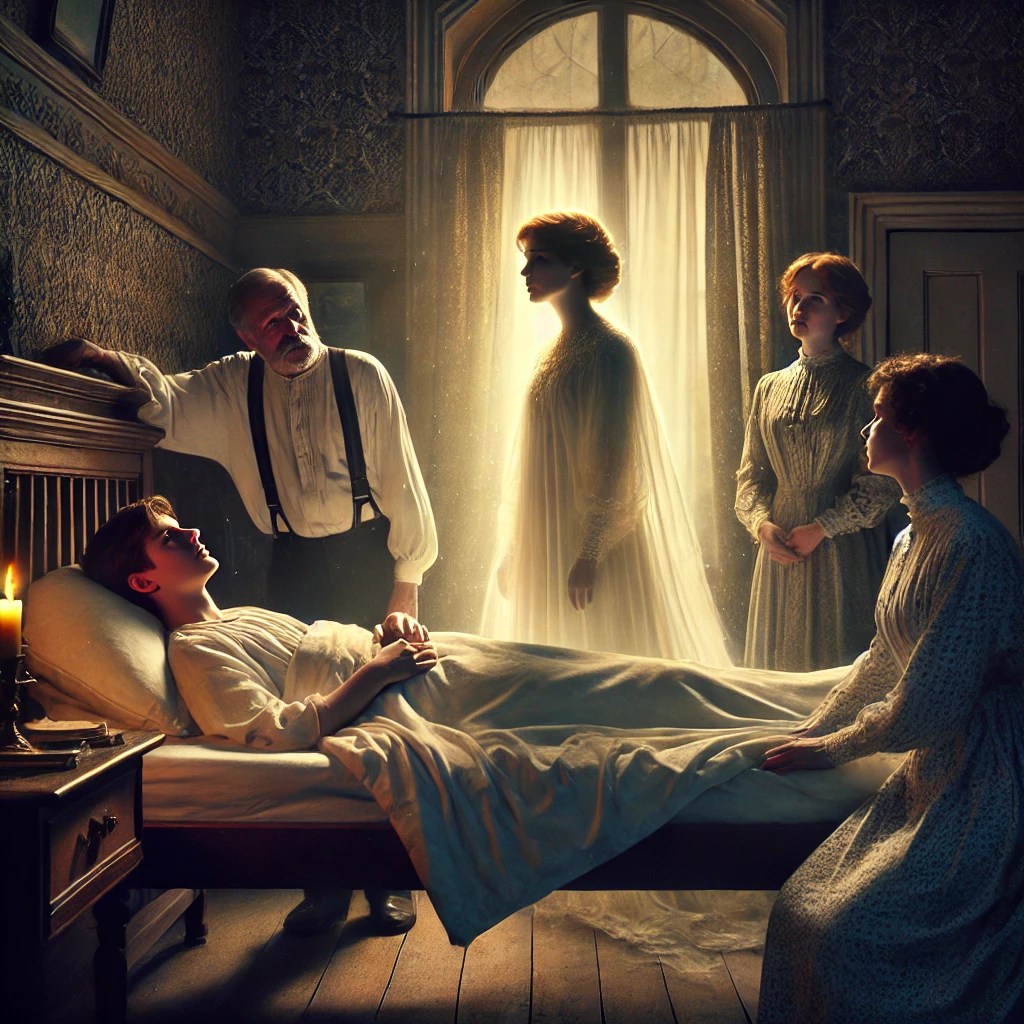
As a pastor, I had visited him in the hospital, but was not present at his death. For regarding his death as extraordinary, I have the statements of his father, Mr. Frank Jenks, Mrs. Warren Beers, the sister of Clifford, and others of the family, who were all with him at his bedside when he passed away. Besides I have interviewed the nurse, who was also present, and her recollection of it accords exactly with the account given by the members of the family I have mentioned. My visit just a few hours before found him calm, confident and perfectly sane. He was a young man of fine record and character. I must not omit saying that he had just undergone an operation for appendicitis, and died a few days after. His own mother was not living. At the time of his death he gave every evidence of being perfectly sane, and was not under the influence of any opiate, or of anaesthetics. He said, “O, glorious, beautiful place to which I am going! Words can never describe it!” Putting his arms about the neck of his brother Leon, he said, “O, Leon, how I wish I could take you all with me. He then singled them out and talked with each one personally, telling them of the wonderful vision he was beholding. He then began talking with his departed mother. Hearing him address his mother, the present Mrs. Jenks came to the bedside and said, “Yes, Clifford, mother is here”—and he said, “O, it is my own mother who is with me.” Then addressing his father, and all about his bedside, personally, with joy on his face shining forth, told them of the marvelous and glorious home to which he was going, that nothing could induce him to stay, he began a joyful song, and sang until his failing strength caused him to cease. “O, my Saviour!” said he, “What a glorious Savior is mine.” And thus it continued till the last breath was drawn. He died with his arms about his brother’s neck, calling him lovingly by name, his last words two minutes before his last being, “O, Leon, Leon, Leon.” The death scene of this dear young man cannot be told in words. There was nothing in his case in the way of opiates or anaesthetics, so they all say, and nothing to indicate anything but his being in a perfectly sane and rational condition of mind, during every moment of this wonderful hour.
J. W. Thompson,
Pastor M. E. Church
Cheshire, Mass., Oct. 29, 1906.
Dear Aunt Sarah:—
It is with a sad heart that I write you today to let you know the particulars of the death of our dear boy. I know that you anxiously await them. He came home from the office October 2nd, staid [sp.] at home the balance of the week. He saw the doctor, who said “he had symptoms of appendicitis or typhoid fever.” He got better and went back to work Monday, Oct. 8th; worked until Thursday evening; came home; grew worse, and Sunday at 11 a.m. was operated on for appendicitis at the House of Mercy in Pittsfield. He seemed to hold his own or a little better until Wednesday morning, when he began to fail, and died Friday at 5:30 p.m.
He suffered untold agony and grew so thin that you would hardly know him. I wish you could have been at his bedside and witnessed his last hours on earth. I cannot describe that scene to you in all its grandeur.
About 4 o’clock, or an hour and a half before he died, he began to say “I’m going home.” Then he closed his eyes and after a little opened them and said, “Where have I been? Oh; I will tell you,” said he, as though he had been to the other world and allowed to come back for a brief time to make his report to us, who stood around his bedside, “I will tell you, I’ve been billions and billions of miles away to a Happy Land. Oh! how glorious! I can’t describe it and I’m going back there, too. Oh! I’m so happy! I never was so happy in all my life! I never felt so good; my mother calls me, she wants me to come where she is. Oh, how happy, how happy I am!” At times he talked about his Saviour; Felt His Presence, said “Christ set me free, Take me to thyself.” Sang hymns; told us over and over how happy he was, and talked again about his mother. He said, “Mother is here, right here in this room.”
Leon stood at the head of the bed, and Clifford, looking up, said, “Leon, don’t you want to see your mother, don’t you want to go with me?” Leon said, “Yes, Clifford,” who seemed so pleased at that reply that he reached up, throwing his arm around Leon’s neck, pulling him down to the bed, said, “Come on, then.” He called us all by name, asked us to go with him.
When he was talking about his mother, I called Clara to the bedside to be satisfied which mother he meant, and Clifford said, “no, my other mother.” He talked thus for about an hour, and such a scene of triumph has been seldom witnessed. The nurse, who is accustomed to death-bed scenes, said she “never saw anything like it.” He also noticed Mildred standing at the foot of the bed and said, “Mildred, don’t you want to see your mother?”
I have not space to write all he said and I could not tell you if I were talking to you. But in all he said we noticed no mistake. He seemed to see those on the other shore as plainly as us who stood by his side. He was a good Christian boy and had splendid principles. How little we thought when you were here we should so soon be called to part with him. How we do miss him. It seems as if I could not have it so, but God’s will be done. I was sorry you did not get telegram in time to come to the funeral. Clara and I intend to go away somewhere soon for a while. Hoping to see you soon I remain,
Sincerly yours,
Frank J. JenksCheshire, Mass., Jan. 26, 1907.
Dr. James H. Hyslop,
Dear Sir:—
In reply to yours of the 18th I should infer that you had not received a letter from the Rev. J. W. Thompson, pastor of the Methodist Church of Cheshire.
As the matron of the hospital would not permit me to use the name of the nurse I had the Rev. J. W. Thompson see her and talk with her. He probably has written you in regard to it. My son Clifford certainly had a wonderful vision. His mother he talked so much about had been dead almost three years. His age was twenty years. If in the letter you have received it is not explained to your satisfaction you may write me again and I will try and explain more fully.
Very truly yours,
Frank J. JenksCheshire, Mass., Jan. 28, 1907.
James H. Hyslop,
Dear Sir:—
Your letter of the 22nd was handed me by Rev. Mr. Thompson today. As one of the witnesses to my brother’s death will say in reply to your question 1st; that Clifford had a vision of his mother, who died Dec. 12th, 1903; that it was not abruptly separated from the rest of his vision, but woven throughout the whole; that he mentioned her several times during the vision; that the vision lasted an hour or more, as nearly as I can remember, and occurred about, or rather ended about, an hour or so before he died; that he could distinguish clearly between each person in the room, there were 6, all relatives, besides the nurse; that he spoke directly to at least 5 of those present, calling each by name, during the vision; that he said, “I can see my mother, she is right here in the room.” At another time, “My mother has come for me; she wants me to be where she is.”
Later, looking up at me as I stood at the head of the bed, he said, “Leon, don’t you want to go with me to see your mother?” to which I replied, “Yes, Clifford.” He seemed overcome with joy and, throwing his arms up around my neck, said, “I thought you would, come on, then.” At the same time throwing his arm around his sister Hattie’s neck, saying, “I’ll take you, too, Hattie.” His father then spoke, saying, “Don’t you want to take the whole family?” to which he replied, “Yes, I want to take you all.” All in the room were much affected at this period in the talk or vision.
At the latter part of the vision he seemed to be impressed with the idea of going. Seemed anxious to start. Wanted us to get ready to go with him. Seemed to think he could start off bodily, raised up in bed. Of course we had to hold him back, as he probably would have thrown himself out of the bed. Was much distressed that we held him in the bed, saying, “What cruel people to hold me back.”
He prayed, singing, “Oh, Christ, let me go; wilt thou let me go? Christ, the mighty man, thou canst let me go. Thou art all powerful.” At the first part of the talk he seemed calm and extremely happy and talked in quiet, happy strain. At time he would hum tunes, sometimes sing. I do not remember what he sang, but some of the others said he sang hymns.
I was present when the vision began and when it ended, and was only absent a few minutes to call his father, who was down stairs when he commenced to talk. He mentioned seeing his mother and Saviour in his vision and no one else. During one of the times when he was talking of his mother one of the party asked his stepmother, who was sitting in a chair out of Clifford’s sight, to step up to the bed saying to her, “Perhaps he means you,” but as she arose and approached the bed where he could see her, Clifford said, “No, my other mother,” showing that he clearly knew whom he was talking about. At one time during Cliffords talk, being so much impressed with his actions and such a remarkable death-bed scene, I looked over to the nurse and said in a low voice, “Is it morphine?” She shook her head “no.” I afterward heard he had not had morphine for several hours previous to the vision.
At the last of his talking, when he was struggling to go back to that “Happy Land,” where he had been a short time previous in a dream or in spirit, I can’t tell which, and which he told us about (see previous letter) as we kept holding him down, it seemed to irritate him so that the last of his talk was more the expression of an unbalanced mind. To quiet him at this stage he was given injections of morphine and he talked no more; lived perhaps an hour afterward; was restless and seemed to suffer pain. I noted his more labored breathing and feeling that the end was near, as he had given me no sign of recognition for some time, I bent down and said, “Clifford, are you in pain? Do you feel bad?” and he said slowly, three times, “Oh, Leon! Oh, Leon! Oh, Leon!” which was the only reply he made to my question, but which showed that he was conscious and knew me. About five minutes after this his eyes set and after a few more minutes of labored breathing the end came.
This, I believe, is about as good and comprehensive an account as I can give. Should there be anything further you would like to inquire about I should be glad to help you all I can.
Yours truly,
Leon E. Jenks.
Journal of the American Society for Psychical Research, (York: Vol. 12; October, 1918), p. 594-599.
 The Katabasis Project
Leave a comment