
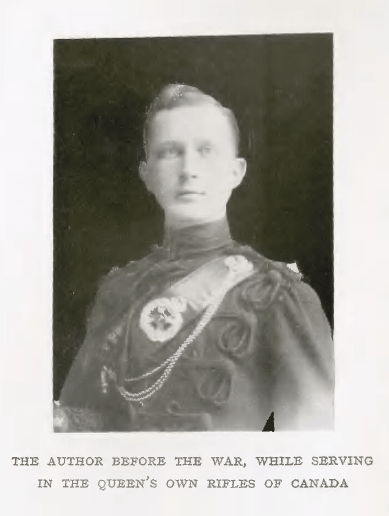
Date: July, 1916 (Battle of the Somme)
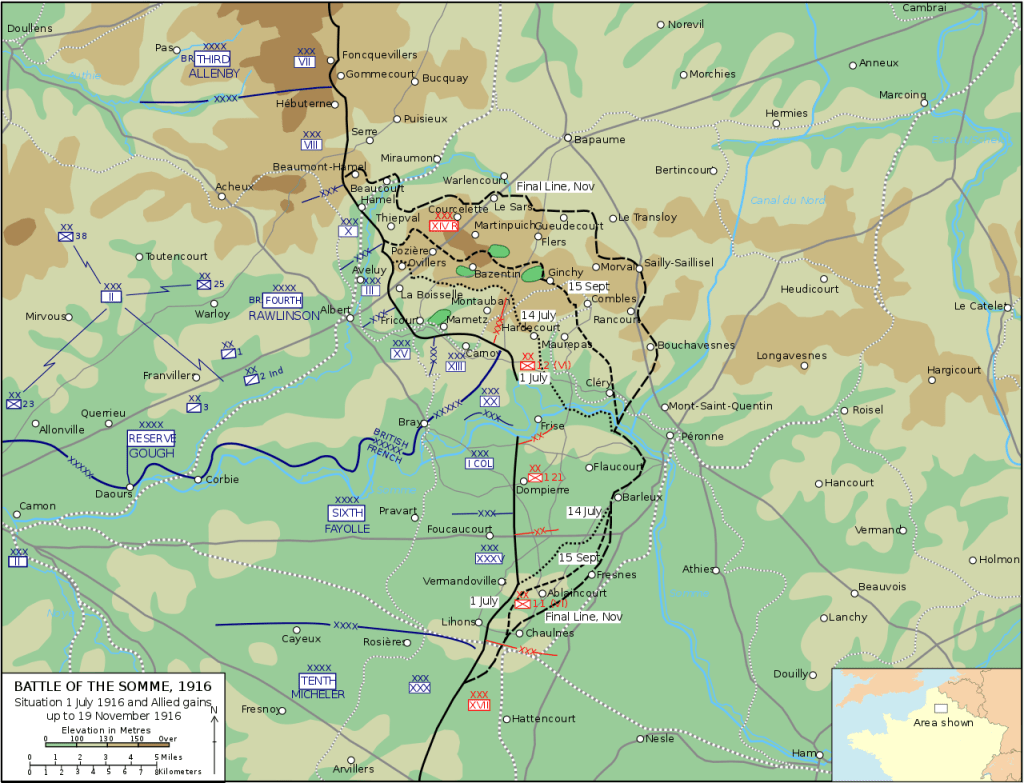
Location: Trônes Wood, Somme, France
I was wounded! I was blind! But the moments that followed are clear in my memory. The brain shocked by a blow works quickly and actively in its excited effort to hold its own.
I was quite conscious and thinking clearly: I knew what had happened and what would happen; I remember every detail.
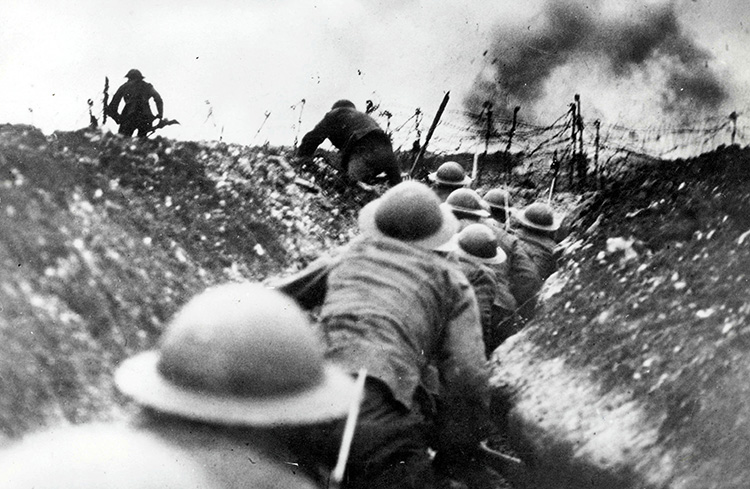
My head at the moment was inclined to the right, for I was shouting to the men. Like a flash I remembered that about fifty yards to the left of me there was a “German strong point” still occupied by the Germans. A bullet had entered my left temple; it must have come from a sniper in that strong point. The bullet had passed clean through my head; I thought it had emerged through my right temple. I was mistaken on that point, for I found some days later that it had emerged through the centre [sp.] of my right eye.
I remember distinctly clutching my head and sinking to the ground, and all the time I was thinking, “So this is the end—the finish of it all; shot through the head, mine is a fatal wound.”
Arnold jumped up, and catching me in his arms, helped me back into the shell-hole.


I hesitated to tell what followed. But as I am trying to record the sensations experienced at the time of receiving a head wound, I will describe the next experience simply, and leave the reader to form his own conclusions.
I was blind then, as I am now; but the blackness which was then before me underwent a change. A voice from somewhere behind me said: “This is death, will you come?”
Then gradually the blackness became more intense. A curtain seemed to be slowly falling; there was space; there was darkness, blacker than my blindness; everything was past. There was a peacefulness, a nothingness; but a happiness indescribable.
I seemed for a moment somewhere in the emptiness looking down at my body lying in the shell-hole, bleeding from my temple. I was dead, and that was my body; but I was happy!
But the voice I had heard seemed to be waiting for an answer. I seemed to exert myself by a frantic effort, like one in a dream who is trying to awaken.
I said: “No, not now; I won’t die.” Then the curtain slowly lifted; my body moved and I was moving it. I was alive!
There, my readers, I have told you, and I have hesitated to tell it before. More than that, I will tell you that I was not unconscious; neither did I lose consciousness until several minutes later, and then unconsciousness was quite different.
I have told you how clear was my brain the moment I was hit, and I tell you also that after the sensation I have just related, my brain was equally clear, as I will show you, until I became unconscious.
Call it a hallucination, a trick of the brain, or what you will. I make no attempt to influence you; I merely record the incident—but my own belief I will keep to myself.
Whatever it was, I no longer feel there is any mystery about death. Nor do I dread it...
…I have heard people say that when a person is drowning, after the first frantic struggles are over, a delightful sensation of peacefulness comes over him, and he ceases to desire to help himself. That was how I felt at that moment. This shell-hole was my grave. Well, it seemed quite right and proper.
Nobbs, Gilbert, Englishman, Kamerad! (London: W. Heinemann, 1918), 102-111.
Light (February 8, 1919), p. 46
 The Katabasis Project
Leave a comment