
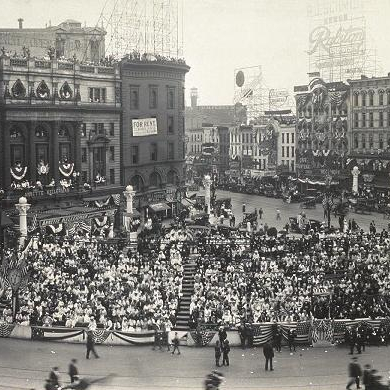
Date: Circa 1903.
Location: Detroit, Michigan
It was about four o’clock, and the dawn for which he had been watching was creeping in through the shutters, when, as I bent over the bed, I noticed that his face was quite calm and his eyes clear. The poor fellow looked up into my face, and taking my hand in both of his he said : “ You’ve been a good friend to me, doctor. You’ve stood by me.” Then something which I shall never forget to my dying day happened ; something which is utterly indescribable. While he appeared perfectly rational and as sane as any man I have ever seen, the only way that I can express it is that he was transported into another world, and although I cannot satisfactorily explain the matter to myself, I am fully convinced that he had entered the Golden City—for lie said in a stronger voice than he had used since I had attended him : “There is mother! Why, mother, have you come here to see me? No, no, I’m coming to see you. Just wait, mother, I am almost over. I can jump it. Wait, mother.”
On his face there was a look of inexpressible happiness, and the way in which he said the words impressed me as I have never been before, and I am as firmly convinced that he saw and talked with his mother as I am that I am sitting here.
In order to preserve what I believed to be his conversation with his mother, and also to have a record of the strangest happening of my life, I immediately wrote down every word he had said. These were the last intelligible words he uttered. He lapsed back into his former delirium, after having had what I firmly believe was a conversation with that mother who died when he was but eighteen months old, and of whom he had not the slightest remembrance. His was one of the most beautiful deaths I have ever seen.
“Vision of a Dying Man,” Light: A Journal of Psychical, Occult, and Mystical Research (August 29, 1903), p. 418
Ernesto Bozzano, Phénomènes Psychiques au Moment de la Mort (JMG éditions, Agnières, 2001), p. 17.
William F. Barnett, On the Threshold of the Unseen, (New York: E. P. Dutton & Company, 1918), p. 158-159.


Leave a Reply